


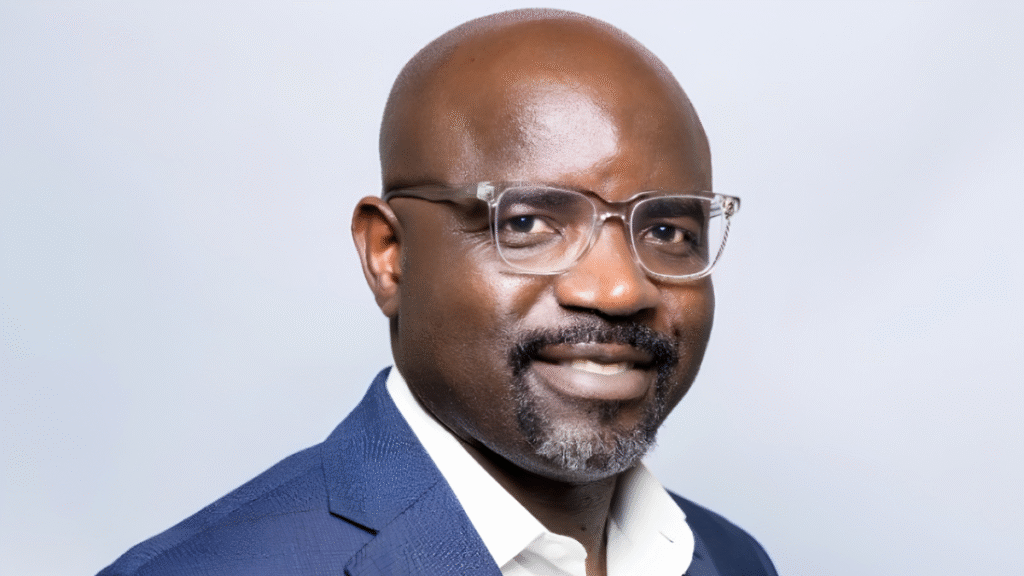
In the global economy now taking shape, the most important technological battles are no longer being fought only in consumer apps, social networks or entertainment platforms. They are moving into quieter, more strategic territories: water, energy, urban networks, public infrastructure, industrial systems and complex operations. It is in this space, where data meets the physical world and artificial intelligence must prove its value in real systems, that Asong Suh’s career now finds its sharpest expression.
A Cameroonian by origin and based in the United States, Asong Suh belongs to a rare category of African diaspora leaders who have built credibility at the intersection of three demanding worlds: field engineering, high-level strategy consulting and artificial intelligence applied to large organizations. His path does not follow the conventional trajectory of a technology executive emerging directly from a lab or business school. It was built first through technical depth, in the oil and gas industry, close to drilling equipment, operational constraints and global clients. From there, he moved progressively into management, strategy, digital transformation and the leadership of enterprise-scale AI solutions.
Since July 2025, Asong Suh has served as Managing Director, Public Sector & Water Utilities at Sand Technologies, after previously leading the company’s Customer Solutions function. The move is significant. It places him at the heart of a critical segment: the use of artificial intelligence to improve the performance of public services, water networks, urban infrastructure and essential systems. In a world facing ageing networks, climate pressure, water scarcity, budget constraints and rising expectations for service continuity, this type of leadership has become central.
Sand Technologies positions itself around a powerful idea: making AI not merely a tool for analysis, but an intelligent control layer for complex physical infrastructure. The stakes are considerable. In water networks, for instance, artificial intelligence can help detect leaks, predict failures, reduce non-revenue water, optimize treatment processes and improve maintenance. In the public sector, it can provide better operational visibility, help decision-makers anticipate breakdowns, allocate resources more effectively and improve the quality of services delivered to citizens. For a leader such as Asong Suh, the issue is therefore not only technological. It is economic, operational and institutional.
His current legitimacy rests on a particularly dense professional foundation. Before joining Sand Technologies, he spent two years at C3 AI, a recognized player in enterprise artificial intelligence, where he held the roles of Principal Solutions Leader and then Senior Director, Customer Solutions. At that level, his work involved leading teams focused on helping major companies, particularly in the energy sector, unlock economic value through AI and machine learning. This is not a minor detail. Enterprise AI is not an abstract promise. It requires an understanding of industries, data, processes, human constraints, existing systems and the real ability of an organization to turn an analytical model into operational decision-making.
That ability to translate between worlds appears to be one of the defining features of Asong Suh’s career. He is not only an engineer, not only a consultant, not only a commercial or solutions leader. He sits at the intersection of these roles. He can read an industrial problem, understand its economic implications, mobilize technical teams, structure a client response and carry a strategic vision. In the world of AI applied to infrastructure, this combination has become one of the most valuable forms of expertise.
His time at McKinsey & Company, between 2018 and 2022, reinforced that strategic dimension. Based in Houston, one of the world’s major energy hubs, he served clients in oil and gas, chemicals, materials, private equity, utilities, mining, equipment manufacturing and industrial sectors. First as an Associate, then as an Engagement Manager and later as a Solution Leader, he led teams of consultants, data scientists, data engineers and sector specialists on issues including digital transformation, advanced analytics, artificial intelligence, strategy, procurement, operations and organizational design.
That McKinsey chapter matters because it marked his shift from an industrial engineering profile to that of a transformation architect. In large companies, technology only creates value when it changes performance: reducing costs, improving reliability, optimizing capital allocation, increasing productivity, reducing risk and accelerating decision-making. Asong Suh learned to connect technical capabilities with the priorities of executive leadership. This competence is now decisive in artificial intelligence, where many organizations invest heavily without always knowing how to convert experiments into measurable impact.
But the singularity of his profile also comes from his long tenure at Scientific Drilling, where he spent more than thirteen years. That is where he developed his culture of field execution, industrial technology and global client engagement. He began as an Electrical Engineer in California, working on algorithms and electronic equipment used in oil and gas drilling. He later moved into Applications & Support Engineering, with growing technical and customer-facing responsibilities. He became a global subject matter expert in Logging While Drilling technologies, worked with engineering teams to develop, test and commercialize new technologies, operated drilling equipment in the field and trained teams.
This first part of his career is essential to understanding the executive he has become. Drilling, particularly in its real-time measurement and logging dimensions, is a demanding school. Mistakes are costly. Environments are complex. Data must be interpreted quickly. Equipment must function under extreme conditions. Operational decisions cannot wait. This culture of precision, robustness and responsibility naturally carries over into his current work in artificial intelligence for critical infrastructure.
Between 2011 and 2015, Asong Suh became Global Product Line Manager at Scientific Drilling, with worldwide responsibility for a Logging While Drilling product line valued at more than $36 million. This role broadened his scope even further: product strategy, client relations, engineering, manufacturing, marketing, sales, operations and the commercialization of new technologies. He was no longer simply dealing with a product. He was managing a global business line, with growth objectives, investment decisions, market constraints and profitability requirements. From 2015 to 2017, as Global Business Account Manager, he took responsibility for relationships with some of the company’s strategic clients, with a clear objective: aligning client interests with company priorities to drive revenue growth, customer satisfaction and profitability.
His academic background also helps explain this trajectory. He holds a Bachelor’s Degree in Electrical Engineering from the United States Naval Academy, where he graduated with merit, followed by a Master’s Degree in Electrical Engineering from California Polytechnic State University, San Luis Obispo, obtained with distinction. He later completed an MBA at Rice Business, where he was a Jones Scholar, a distinction associated with the top 10% of his class, with a focus on strategy, finance and entrepreneurship. This combination of scientific rigor, academic excellence and managerial training partly explains his ability to operate in environments that require both technical depth and economic judgment.
For Cameroon, Asong Suh’s journey carries particular significance. It shows that the Cameroonian diaspora is not limited to visible profiles in medicine, finance, entrepreneurship or international institutions. It also includes leaders positioned in highly sophisticated technological segments, at the center of transformations that are redefining the infrastructure of the twenty-first century. As African countries seek to modernize water networks, secure energy systems, digitize public services and improve the performance of urban infrastructure, this type of expertise becomes strategic.
Asong Suh’s story also says something about African leadership in global technology. It reminds us that impact is not measured only by the creation of a start-up or media visibility. It can also be built through the ability to lead complex teams, solve large-scale industrial problems, transform critical organizations and introduce artificial intelligence into sectors where the margin for error is narrow. It is a quieter form of leadership, but often a more structural one.
In a world fascinated by generative AI, Asong Suh embodies another conversation: AI that keeps cities running, reduces water losses, improves networks, anticipates failures, optimizes industrial assets and helps decision-makers govern complex systems more intelligently. For African economies, this approach may be among the most promising. The continent does not only need digital applications. It needs operational intelligence, robust systems, usable data and leaders capable of turning technology into real performance.
Through his career, Asong Suh emerges as one of those Cameroonian diaspora talents whose trajectory deserves attention: an engineer who became a strategist, a field operator who became an AI solutions executive, a technical profile who now helps build value for essential infrastructure. In that progression, he does not merely represent an individual success story. He embodies a broader possibility: Cameroonian expertise capable of contributing, at the highest level, to the technological transformation of the systems that structure the global economy.
Mérimé Wilson